GUWAHATI: Nearly a year after Zubeen Garg’s death, his close friend Partha Pratim Goswami has reiterated his demand for justice, saying that emotional tributes alone cannot bring closure while the legal battle continues.
Speaking to the media, Goswami said Zubeen had devoted much of his life to Assam and its people, but the fact that justice was still awaited remained deeply painful for those close to him.
“Zubeen gave so much to Assam and its people,” Goswami said, arguing that the most meaningful tribute now would be to ensure justice through the ongoing legal process.
‘There Will Be No Compromise on Justice’
Goswami expressed confidence in the judicial process and said he firmly believed that justice would eventually be delivered.
He referred to the investigation carried out by the Special Investigation Team (SIT) and the subsequent court proceedings, saying the case had reached its present stage only after an extensive investigation.
With the matter now before the court, Goswami acknowledged that there were limits to what they could publicly say.
However, he maintained that there would be “no compromise” when it came to seeking justice for Zubeen.
He also criticised what he described as lengthy questioning of individual witnesses by defence lawyers, claiming that some witnesses were being examined for several days.
These observations represent Goswami’s assessment of the proceedings and should not be construed as findings by the court.
Goswami Questions Bail Attempts
Goswami also spoke strongly about bail applications filed by the accused.
He expressed concern over what could happen if those facing serious charges were released on bail and required to physically appear before the court during the trial.
Goswami further referred to attempts to have the case moved outside Assam and questioned why the trial should be shifted when proceedings are already underway before a fast-track court in the state.
His remarks reflect his personal opposition to bail and any transfer of the case. Whether bail is granted or a case is transferred remains entirely a matter for the competent courts to decide under law.
Water Factory Controversy Raises Fresh Questions
One of the strongest parts of Goswami’s statement concerned a water factory that he alleged was connected to one of the accused.
According to Goswami, he received information that the factory was operating despite having previously been sealed. He claimed that people later visited the location and saw production activity as well as vehicles transporting water from the premises.
Goswami questioned how a factory could allegedly resume operations after being sealed under a court order.
He also raised questions about whether the local police and senior district authorities were aware of the alleged activity.
“If a factory was sealed following a court order, how was production continuing?” was the central question raised by Goswami.
The allegations regarding the factory and the circumstances under which it allegedly operated would, however, require verification from the relevant authorities and court records.
‘Could This Happen Without Powerful Support?’
Goswami went a step further and expressed suspicion that influential people may have helped facilitate the alleged operation of the factory.
He questioned whether such activity could have continued without support or protection from powerful individuals.
However, Goswami did not present documentary evidence in his media interaction identifying any particular influential person as being involved. His remarks therefore remain an allegation and a demand for further scrutiny, rather than an established finding.
‘Zubeen Cannot Be at Peace Until Justice Comes’
Speaking about remembrance events for Zubeen, Goswami became emotional and said that, for him personally, commemorative programmes could not substitute for justice.
He said annual observances may be held as part of tradition, but he personally did not feel that Zubeen could truly be given peace while the question of justice remained unresolved.
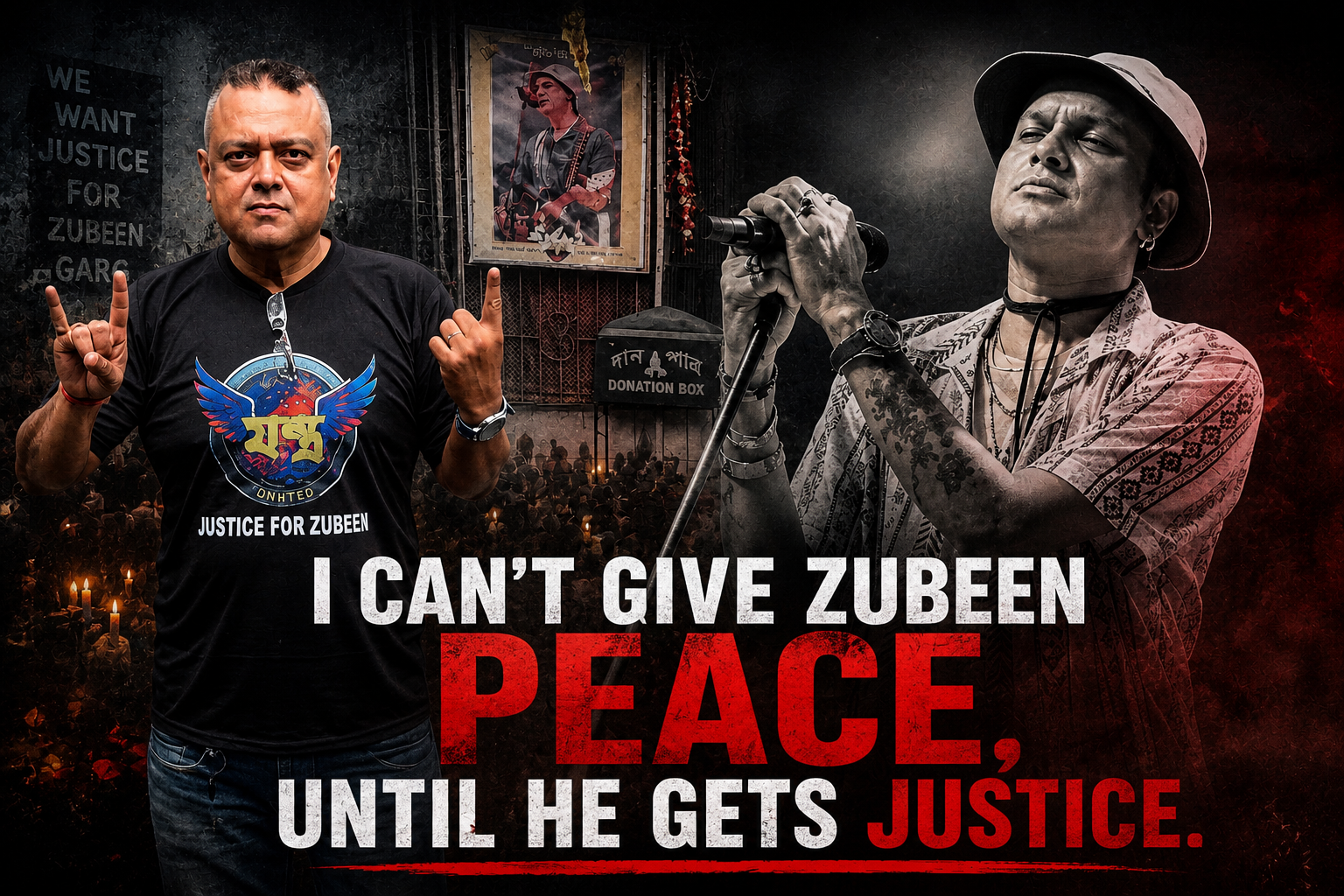
“How can we give Zubeen peace until he gets justice?” Goswami said.
He also referred to a recent incident in which lightning reportedly struck near a location displaying a large cutout of Zubeen. Goswami interpreted the incident emotionally as a symbol of Zubeen’s “anger and pain”.
He explicitly described that interpretation as his personal belief, rather than a factual connection between the natural event and the ongoing case.
For Goswami, however, the larger message remains unchanged: the remembrance of Zubeen Garg cannot end with candles, photographs or anniversary programmes.
He wants the legal process to reach its conclusion—and justice, he says, must come first.