By Pradip Dutta Roy
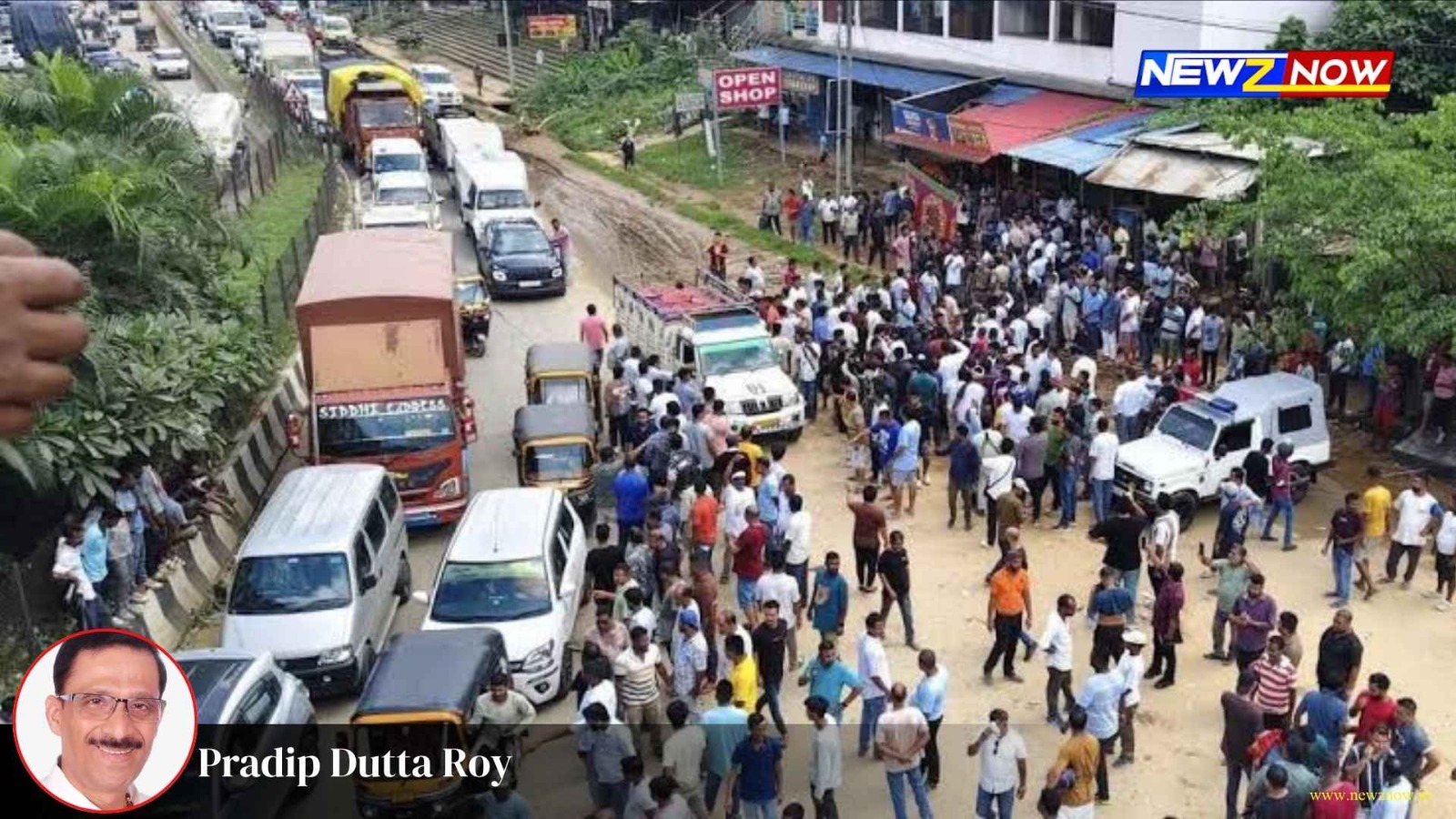
On August 19, the Khasi Students’ Union (KSU) organised a protest march in Shillong, alleging that the state government had ignored its longstanding demands. Among these were a provision for public hearings before the establishment of a cement plant, stronger legislation concerning the safety and security of Meghalaya’s residents, and amendments to laws relating to migrant workers.
However, the protest against the government inexplicably turned violent. Participants allegedly attacked local pedestrians as well as 31 tourist vehicles from Assam. What followed is now well known: blockades and counter-blockades along the Assam-Meghalaya border, government intervention, the arrest of KSU leaders, and a subsequent easing of tensions. The situation is presently under control, although an undercurrent of tension remains.
Yet, amid all the turmoil, one aspect of the incident appears to have received little or no attention from either the Meghalaya or Assam governments.
During the same protest, the statues of Netaji Subhas Chandra Bose and Swami Vivekananda at Shillong’s R.R. Colony were vandalised. Stones were thrown at the glass enclosure in front of Swami Vivekananda’s statue, breaking it, although the statue itself was not directly damaged. The bust of Netaji, however, was reportedly smashed and thrown to the ground. More disturbingly, it was allegedly kicked around like a football.
While the Meghalaya government has apparently made no public statement on the matter, the state’s Department of Arts and Culture has reportedly assured that the two statues would be restored and reinstalled.
One may reasonably ask: what possible connection did the vandalism of these revered national figures have with the demands raised by the protest march? And why has there been such silence from the government?
The answer, arguably, lies in a long history of hostility towards those perceived as “outsiders”, particularly Bengalis living in Meghalaya. Such incidents cannot be viewed in isolation. They need to be understood against the backdrop of Meghalaya’s history and the politics that have developed around questions of indigeneity, migration and demographic change.
Let us therefore turn briefly to history.
A Brief Demographic and Historical Background
According to the 2011 Census, Meghalaya had a population of approximately 30 lakh, of whom around 26 lakh belonged to Scheduled Tribe communities and about four lakh were non-tribal. Non-tribal communities include Bengalis, Nepalis, Hajongs, Biyates, Koch-Rajbongshis, Bodos, Dimasa and others. There are also smaller communities of Punjabis, Sikhs, Biharis, Marwaris and others.
The history of non-tribal settlement in Shillong, particularly that of Bengalis, can broadly be traced through several phases.
- The British Colonial Period
In 1874, Shillong was made the capital of the newly constituted Chief Commissioner’s Province of Assam and subsequently developed into an important centre of British civil and military administration.
The expansion of administrative and economic activities created a demand for educated, skilled and dependable manpower. People from different parts of India were therefore brought to Shillong and its surrounding areas.
Bengalis were employed extensively as clerks, teachers, accountants and professionals, while Nepalis were recruited for the military, cattle rearing, transport and other services. Marwaris, Sindhis and Gujaratis became involved in trade and commerce, while people from other communities arrived to meet various economic and administrative needs.
As a result, well before Independence, Shillong and its surrounding areas had acquired a distinctly multicultural and modern character.
- Partition and Its Aftermath
The Partition of 1947 transformed the lives of millions of people. The drawing of the Radcliffe Line rendered countless people refugees in what had once been their homeland. A large proportion, particularly Hindu Bengalis, were forced to migrate to India.
Some settled in Meghalaya, alongside larger refugee settlements in West Bengal, Tripura and Assam. This movement continued into the 1950s.
The Relief and Rehabilitation Colony at R.R. Colony in Shillong, where the Netaji bust mentioned earlier was installed, was established in 1956 through a government rehabilitation initiative for refugees who had arrived from erstwhile East Pakistan.
- The 1960s
Refugees continued to arrive intermittently during the 1960s amid violence and political instability in East Pakistan. A substantial number of those who arrived during this period, however, belonged to tribal communities such as Garos and Hajongs.
- 1971 and After
Whether, and to what extent, migration into Meghalaya took place in 1971 and subsequent years remains a matter requiring credible documentation and evidence.
Nevertheless, the issue has increasingly been framed through the narrative of “illegal immigrants” or “Bangladeshis”, with the entire Bengali community in Meghalaya sometimes being viewed through this prism.
The Formation of Meghalaya and the Roots of Conflict
Meghalaya became a full-fledged state in 1972 and subsequently came under the special constitutional framework of the Sixth Schedule, which provides significant protections and institutional powers for tribal communities.
From this period onwards, tensions between tribal and non-tribal communities increasingly became a political and social issue.
The central question was not merely how to prevent further migration. An equally important question was how people belonging to non-tribal communities who had already been living in the region for generations would be accommodated within the newly formed state.
Several concerns lay behind the growing unease.
There were fears of demographic change and of indigenous communities becoming minorities in their own homeland. There were concerns over land rights, particularly because the Sixth Schedule provides special protections and powers concerning land and resources.
The creation of the new state also significantly increased the political power and influence of indigenous tribal communities. At the same time, non-tribal communities had a substantial presence in government employment, business, transport, trade and various professions. This created an environment of economic competition.
Rapid urbanisation and the economic growth of Shillong further intensified these pressures.
Two additional developments also need to be considered: continuing migration from Assam, West Bengal, Bihar and Nepal, and the wider political repercussions in the region of the anti-foreigner and “Bengali expulsion” movements in Assam during the 1970s and 1980s.
From Tension to Ethnic Violence
The underlying tensions between tribal and non-tribal communities erupted into large-scale ethnic violence in 1979. One of the principal targets was Meghalaya’s Bengali community.
The immediate trigger was reportedly an incident involving the immersion of a Kali idol in the Lamavilla area. The violence subsequently spread to different parts of the state. The Khasi Students’ Union played a prominent role in the agitation and violence.
More than 30 Bengalis were reportedly killed. Houses and commercial establishments were vandalised, looted and set on fire, and large numbers of people were forced to take shelter in relief camps.
In the aftermath, estimates suggest that between 25,000 and 40,000 people eventually left Meghalaya permanently.
The pattern was subsequently repeated, although the targeted communities changed.
In 1987, members of the local Nepali community became targets of attacks by tribal miscreants. Around 20 people were reportedly killed, thousands were displaced, and homes, shops and business establishments were extensively attacked.
In 1992, the targets were local Biharis. More than 20 innocent people were reportedly killed and around a thousand displaced.
There have also been subsequent episodes, including the violence at Langpi along the Assam-Meghalaya border in 2010; the 2018 violence in Shillong’s Punjabi Lane, in which Dalit Sikh residents were targeted; and the 2020 violence at Ichamati near the India-Bangladesh border, in which three people were reportedly killed and around a hundred Bengalis displaced.
The Demographic Question
Interestingly, while Meghalaya’s overall population has grown, the proportion of non-tribal communities declined between 1980 and 2011.
The Bengali share of the population reportedly declined from around 8.95 per cent to 7.84 per cent during this period, while the Nepali share fell from approximately 4.59 per cent to 1.84 per cent.
These figures are important because they raise a fundamental question: if the proportion of several non-tribal communities has declined rather than increased, can demographic anxiety alone justify treating entire communities as potential outsiders?
The Contribution of Non-Tribal Communities
The irony is that the contribution of non-tribal communities, particularly Bengalis, to the development of Shillong and Meghalaya has been substantial.
The Laban Boys’ School was established in Shillong in 1923 with significant Bengali involvement, while New Colony School was established in 1964. Bengalis also played an important role in the establishment of Shillong Law College, the first medical stores and clinics, and various professional services during the 1960s.
Non-tribal communities were also involved in the early development of commerce, transport, administration and other economic activities.
There is, however, little evidence that these communities exercised systematic domination over indigenous tribal communities. On the contrary, for decades many non-tribal residents worked alongside tribal communities and contributed to the socio-economic development of the state.
At the ordinary social level, relationships between the two communities were, and in many places continue to be, characterised by familiarity, cooperation and mutual dependence.
Where Has the State Failed?
A review of the entire history suggests that the concerns of indigenous communities regarding migration, land, employment and demographic change were not entirely without foundation.
But these concerns could have been addressed through dialogue, fair regulation and impartial governance.
Unfortunately, since the violence of 1979, there has been a persistent perception that those responsible for killings, attacks, arson and destruction of property have rarely faced punishment proportionate to the gravity of their crimes.
Instead, the language of “dkhar”—outsider—and “Bangladeshi” has increasingly been applied to non-tribal communities, contributing to their gradual marginalisation.
It is difficult to escape the conclusion that successive governments in Meghalaya have failed to adequately address such activities—whether because of political considerations, fear of organised groups, or a reluctance to confront organisations such as the KSU.
The recent arrest of some senior KSU leaders following the August 19 violence is therefore notable precisely because such action has been relatively unusual.
Some have argued that the prolonged blockade of the Assam-Meghalaya border threatened Meghalaya with shortages of essential goods and economic disruption, forcing the Chief Minister to act.
Whatever the immediate reason, the larger question remains: why has firm and consistent action not been taken earlier?
A Community Living with an Invisible Fear
The cumulative effect has been profound.
For decades, many non-tribal residents of Meghalaya have lived with an invisible sense of insecurity. For more than four decades, their lives have been marked by uncertainty, vulnerability and the constant need for self-protection.
Many may have concluded that silence is the safest option, surrounding themselves with an invisible shield of caution.
What they have rarely received is a sustained assurance that their lives, property and dignity will be protected irrespective of their ethnic identity.
There is also the question of economic opportunity.
At present, tribal communities have 80 per cent reservation in government employment. For many of the remaining positions, proficiency in indigenous tribal languages is reportedly an important requirement, placing non-tribal applicants at a considerable disadvantage.
Consequently, the representation of non-tribal communities in government employment is extremely limited.
Small businesses run by non-tribal residents also face difficulties in renewing trade licences, with applications reportedly being delayed by the authorities of the relevant autonomous district councils on various grounds.
If employment opportunities are restricted and even small businesses face administrative obstacles, the scope for economic competition becomes correspondingly narrower.
The Need for a Minority Development Framework
A few years ago, prominent citizens of Shillong reportedly submitted a memorandum to Chief Minister Conrad K. Sangma seeking the creation of a separate Minority Development Department for the protection and socio-economic advancement of Meghalaya’s non-tribal communities.
There appears to have been little progress on this demand so far.
This deserves serious consideration.
The Constitution guarantees every citizen the right to life, security, equality and dignity. It is difficult to reconcile these constitutional guarantees with a situation in which a section of citizens has lived for decades with the fear that their ethnic identity could make them vulnerable.
Which Way Forward?
The solution cannot lie in denying the legitimate concerns of indigenous communities.
Meghalaya has genuine challenges relating to land, employment, migration, demographic change and the protection of tribal identity. These concerns deserve to be recognised and addressed through lawful and transparent mechanisms.
But protecting indigenous rights cannot mean compromising the constitutional rights of citizens belonging to non-tribal communities.
The way forward must therefore involve a balanced framework—one that protects indigenous land and cultural rights while guaranteeing equal protection of law, security of life and property, and fair economic and political opportunities for long-settled non-tribal residents.
Above all, violence and vandalism must never be legitimised by political considerations. Organisations and individuals responsible for attacks must be held accountable, regardless of their community or political influence.
If the state government is unable or unwilling to ensure these basic constitutional guarantees, intervention by the Union government may become necessary—not to undermine Meghalaya’s special constitutional protections, but to ensure that those protections coexist with the fundamental rights guaranteed to every Indian citizen.
There is no other sustainable alternative.
The restoration of the broken statues of Netaji Subhas Chandra Bose and Swami Vivekananda may well be undertaken.
But the larger question is this:
Who will restore the confidence of Meghalaya’s non-tribal citizens—the confidence that they too have a secure place, equal dignity and legitimate rights in the land they have called home for generations?
(The views expressed are those of the author.)
Pradip Dutta Roy is the founder-president of AACKSA and an advocate practising at the Gauhati High Court.