Sivasagar: Questions have been raised on social media over the houses being built for flood-affected families in Assam under ‘Aashiyana’, an initiative associated with Bollywood actor Salman Khan and Global Sikhs.
Some social media posts have questioned the quality of the houses, while others have raised questions about the amount reportedly being spent on each unit.
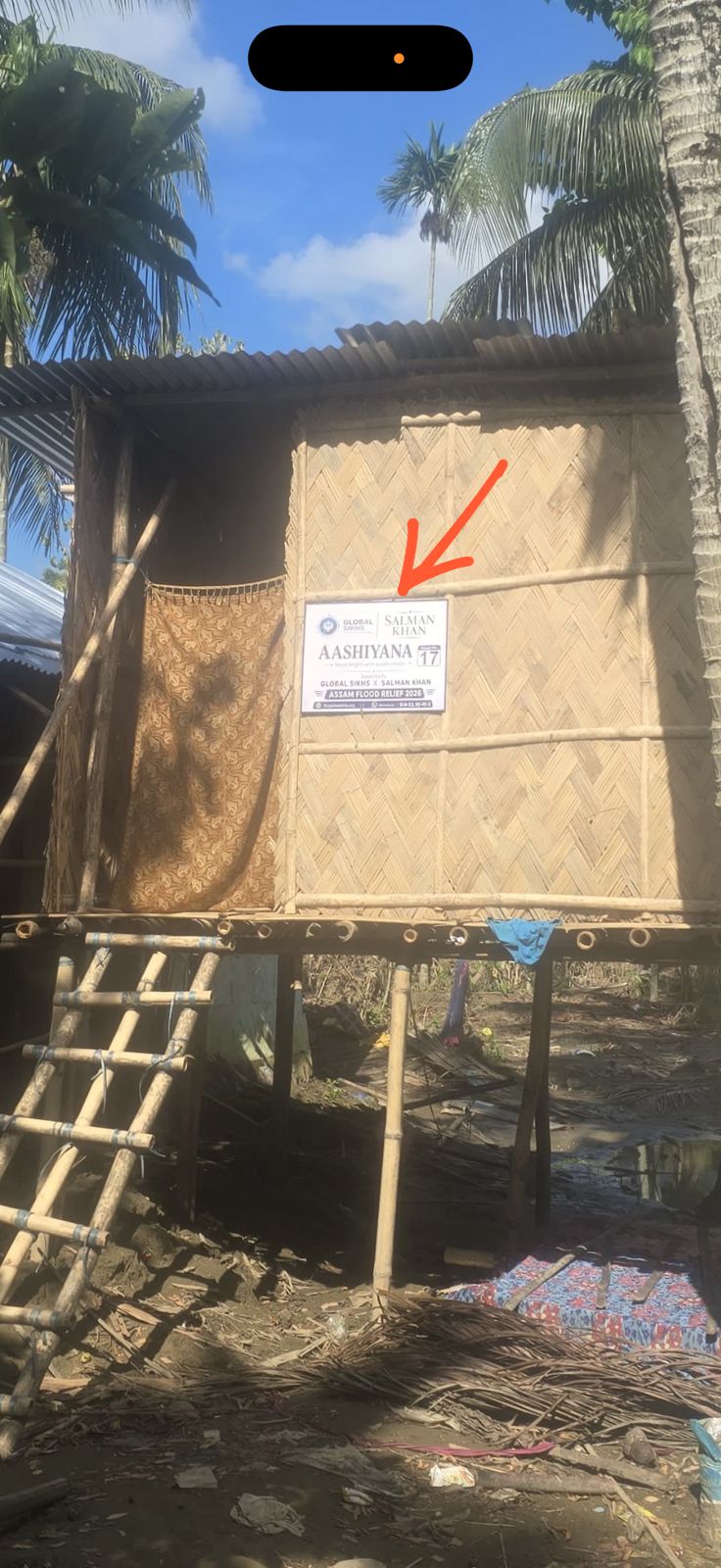
Photos circulated in social media
Rather than relying only on photographs circulating online, NewzNow journalist visited Nepalikhuti in Sivasagar a few days ago and inspected some of the houses built under the project.
What we found on the ground was broadly consistent with what Global Sikhs has been describing from the beginning: semi-permanent shelters made primarily of bamboo and tin, designed for families affected by floods.
NewzNow also spoke separately to the Global Sikhs office and Savneet Singh, who is overseeing the construction work in Sivasagar, to understand the project and its progress.
What did NewzNow see in Nepalikhuti?
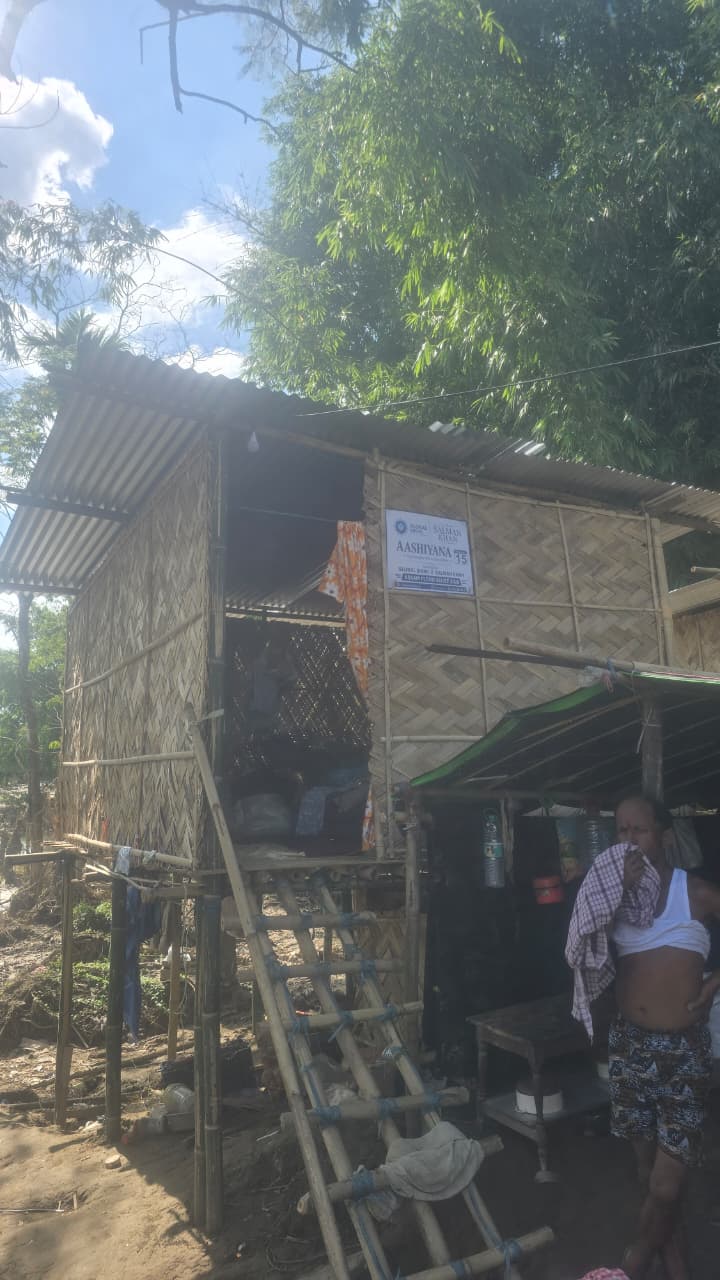
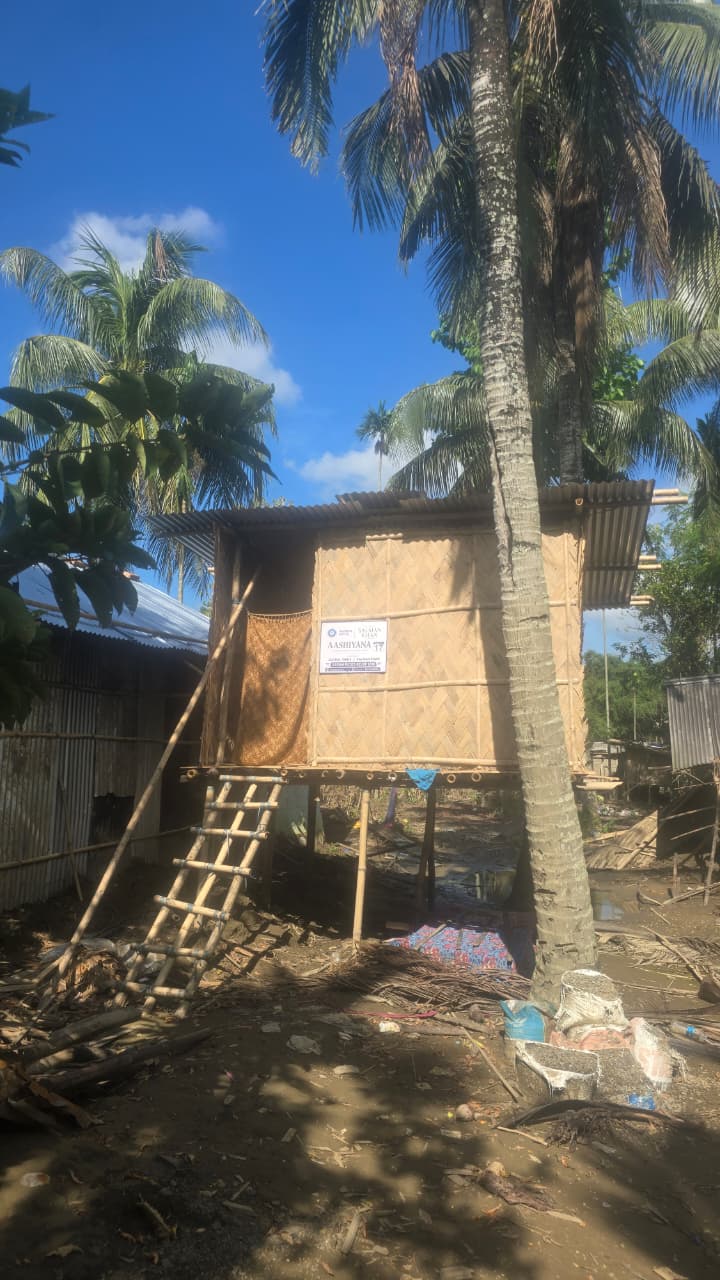
The houses visited by the NewzNow team have bamboo frames, bamboo and cane walls and tin roofing. They are raised somewhat above ground level.
The houses are not conventional permanent concrete structures. They are being built as semi-permanent shelters, with the stated aim of providing flood-affected families with a roof over their heads within a relatively short period.
The houses also carry boards identifying the initiative as “Global Sikhs × Salman Khan – Aashiyana” and “Assam Flood Relief 2026.”
NewzNow with Global Sikhs volunteers at a construction site at Nepalikhuti
The field visit is significant because it confirms that the houses shown in social media posts are not merely promotional images. The project is being implemented on the ground, and houses have actually been constructed for affected families.
At the same time, a visual inspection alone cannot establish how long a particular house will last or how it will perform during a future flood. Those questions require technical and long-term assessment.
More than 100 houses completed, says Global Sikhs
NewzNow contacted the Global Sikhs office to get an update on the project.
The organisation told NewzNow that more than 100 houses have already been completed, while assessments have been carried out for more than 150 houses.
Global Sikhs’ website also currently mentions work on more than 150 houses under its Assam flood-relief initiative.
Around 20 volunteers working in flood-hit areas
According to Global Sikhs, around 20 volunteers are currently working in flood-affected areas.
The volunteers are working with local people, while local labourers are being engaged in the actual construction of the houses.
NewzNow also spoke to Savneet Singh, who is overseeing the construction work in Sivasagar.
His account broadly confirms that the project is being carried out with the involvement of people from the area, including local workers.
This means the work is not being done entirely by volunteers brought in from outside. Local labour is also being used to build the houses.
How much does each house cost?
This remains one of the key questions surrounding the project.
A Mid-Day report published on August 6 quoted Global Sikhs founder Amarpreet Singh as saying that the estimated cost of a bamboo-and-tin house was around ₹35,000 to ₹40,000.
The same project details were subsequently reported by outlets including The Times of India, Bollywood Hungama, NewsBytes and Anandabazar Patrika.
However, those figures relate to the earlier stage of the project.
NewzNow specifically asked Global Sikhs about the current cost of constructing each house.
The organisation declined to disclose the figure, describing the cost details as an internal matter.
Therefore, NewzNow has not independently confirmed the present cost of each house.
What about the ₹2.5 lakh claim?
Some social media posts and videos have suggested that around ₹2.5 lakh has been allocated for each house.
NewzNow, however, has not found any document, project budget or statement from Global Sikhs confirming that figure.
It would therefore be premature to present ₹2.5 lakh as the actual cost of each Aashiyana house.
The only specific cost figure previously reported by established media outlets is the ₹35,000–₹40,000 estimate quoted from Global Sikhs founder Amarpreet Singh.
The original target was 500 houses
When the Aashiyana initiative was first reported, the stated target was to build 500 semi-permanent houses for flood-affected families.
A Mid-Day report dated August 6 quoted Amarpreet Singh as saying that around 220 houses had been completed at that stage.
Similar details about the initiative and its 500-house target were reported by The Times of India, Bollywood Hungama, NewsBytes and Anandabazar Patrika.
The latest figures provided directly to NewzNow by Global Sikhs are that more than 100 houses have been completed and more than 150 houses have been assessed.
What the field visit tells us — and what it does not
The NewzNow visit to Nepalikuchi provides one important piece of clarity.
Houses built by Global Sikh in association with Salman Khan
Global Sikhs is actually building the kind of houses it has described publicly — bamboo-and-tin, semi-permanent shelters for flood-affected families.
But the visit does not, by itself, answer every question.
The actual cost of construction, the quality and grade of materials used, the expected lifespan of the structures and their performance during future floods are separate questions.
Global Sikhs has chosen not to disclose its current per-house cost to NewzNow, calling it an internal matter. That fact should also be part of the public discussion.
For now, what can be established is that the project is active on the ground, more than 100 houses have been completed according to Global Sikhs, assessments have been carried out for more than 150 houses, around 20 volunteers are working in the affected areas, and local labourers are being used for construction.
Beyond that, the numbers circulating on social media — particularly the ₹2.5 lakh per-house claim — should be treated cautiously unless documentary evidence emerges.
Sources and How NewzNow Verified the Story
Global Sikhs Office — Direct communication with NewzNow
NewzNow contacted the organisation’s office directly regarding the number of houses completed, houses assessed, volunteers working in Assam and construction costs. Global Sikhs said more than 100 houses had been completed and more than 150 had been assessed. The organisation declined to disclose the current construction cost per house, calling it an internal matter.
Savneet Singh — Sivasagar construction site
NewzNow spoke directly to Savneet Singh, who is overseeing the construction work in Sivasagar. Information regarding the involvement of local people and local labourers was obtained from him.
NewzNow field visit — Nepalikhuti, Sivasagar
A NewzNow journalist visited Nepalikhuti a few days before publication and inspected several houses built under the Aashiyana initiative. NewzNow also has video footage from the visit showing the construction and materials used.
Global Sikhs official website
The organisation’s website currently carries information about more than 150 houses shortlisted and work started under the Assam flood-relief initiative.
Mid-Day — August 6, 2026
Reported the Aashiyana initiative, the 500-house target and an estimated ₹35,000–₹40,000 cost for a bamboo-and-tin house, quoting Global Sikhs founder Amarpreet Singh.
The Times of India — August 6, 2026
Reported details of the initiative, including the target and the early progress of the housing project.
Bollywood Hungama
Published details of the Aashiyana initiative, its housing target and the initial estimated construction cost.
NewsBytes
Reported details of the initiative based on information published around its launch.
Anandabazar Patrika
Reported on the 500-house target, early progress and the initial estimated construction cost.
NewzNow’s photographs and video
The material available with NewzNow shows houses carrying Aashiyana/Global Sikhs × Salman Khan and Assam Flood Relief 2026 identification boards.
NewzNow’s position
This report does not declare the project a success or allege any financial irregularity.
It does something simpler: we went to the location, looked at the houses ourselves, spoke to the organisation’s office, spoke to the person supervising construction locally, and compared the information with earlier published reports.
The result is a more complete picture than what is currently available through social-media posts alone.