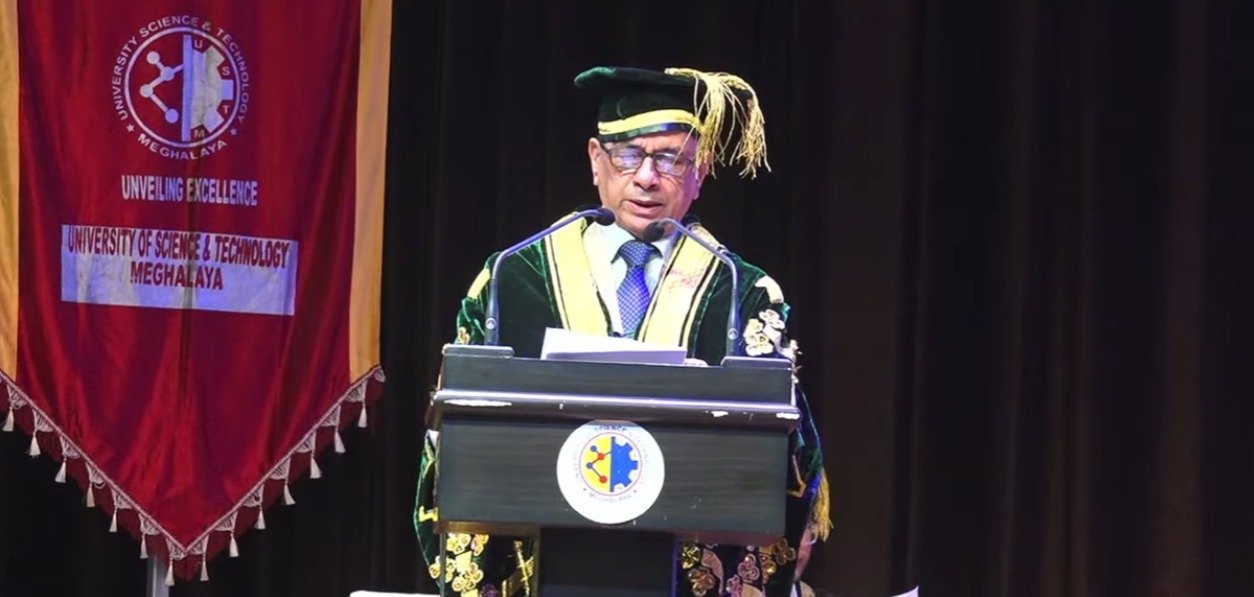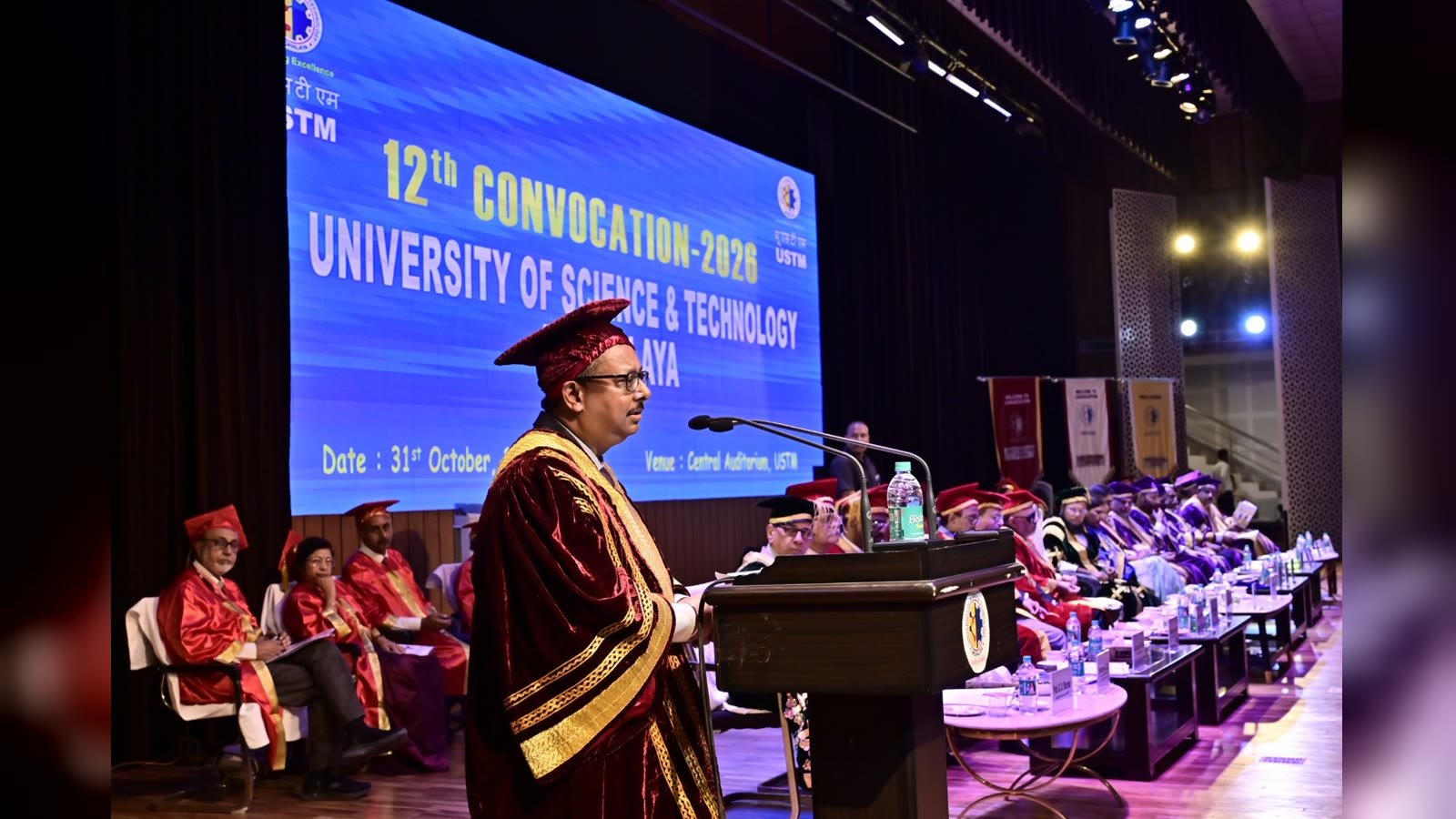
Ri-Bhoi, November 1: “When a society becomes afraid to ask questions, authoritarianism begins,” Supreme Court Justice Ujjal Bhuyan said on Saturday, emphasising the importance of questioning, reasoning and open debate in a healthy democracy.
Addressing the convocation ceremony of the University of Science and Technology Meghalaya, Justice Bhuyan said a society that fears questions becomes vulnerable to authoritarianism. He observed that when traditions are placed beyond questioning and scrutiny, the possibility of reforming unjust practices becomes weaker.
Referring to Article 51A of the Constitution, which lists developing a scientific temper as a fundamental duty of every citizen, Justice Bhuyan said it was not merely about acquiring scientific knowledge. It also involved developing a mindset based on reason and rational thinking.
He said scientific temper encourages people to remain curious, ask questions, investigate claims and make corrections whenever necessary.
According to Justice Bhuyan, scientific temper forms the foundation of the rule of law. Arbitrary power, he said, thrives on ignorance, fear and unquestioned beliefs. A society that accepts claims without evidence can easily fall prey to superstition and misinformation.
Questions and Debate Essential for a Healthy Democracy
Emphasising the importance of debate, Justice Bhuyan said people who ask questions must also be willing to listen to and understand differing viewpoints. The willingness to engage with others through meaningful and reasoned discussions, he said, strengthens society.
He also stressed that access to information is essential for enabling questions and healthy public debate.
Drawing extensively from Nobel laureate economist Amartya Sen’s book The Idea of Justice, Justice Bhuyan explained the distinction between “institutional democracy” and “functional democracy”.
He said public questioning and scrutiny of those in power and institutions are essential for a functional democracy. The circulation of information and its examination through public reasoning and debate help a democratic society establish its relationship with justice.
Calls for Moving Beyond the ‘Us vs Them’ Mindset
Justice Bhuyan also called for abandoning divisive narratives and the “us versus them” mindset to preserve India’s unity and diversity.
He said building a more just and humane society requires people to move beyond divisive thinking and embrace unity and collective belonging.
Referring to the Preamble of the Constitution, which begins with the words “We, the People of India”, he said the Constitution recognises all citizens as equal members of the constitutional order.
He emphasised that individual and community identities do not weaken the country’s shared constitutional unity.
Justice Bhuyan further observed that diversity is not an obstacle to the constitutional framework; rather, it gives the framework its real meaning and substance.